

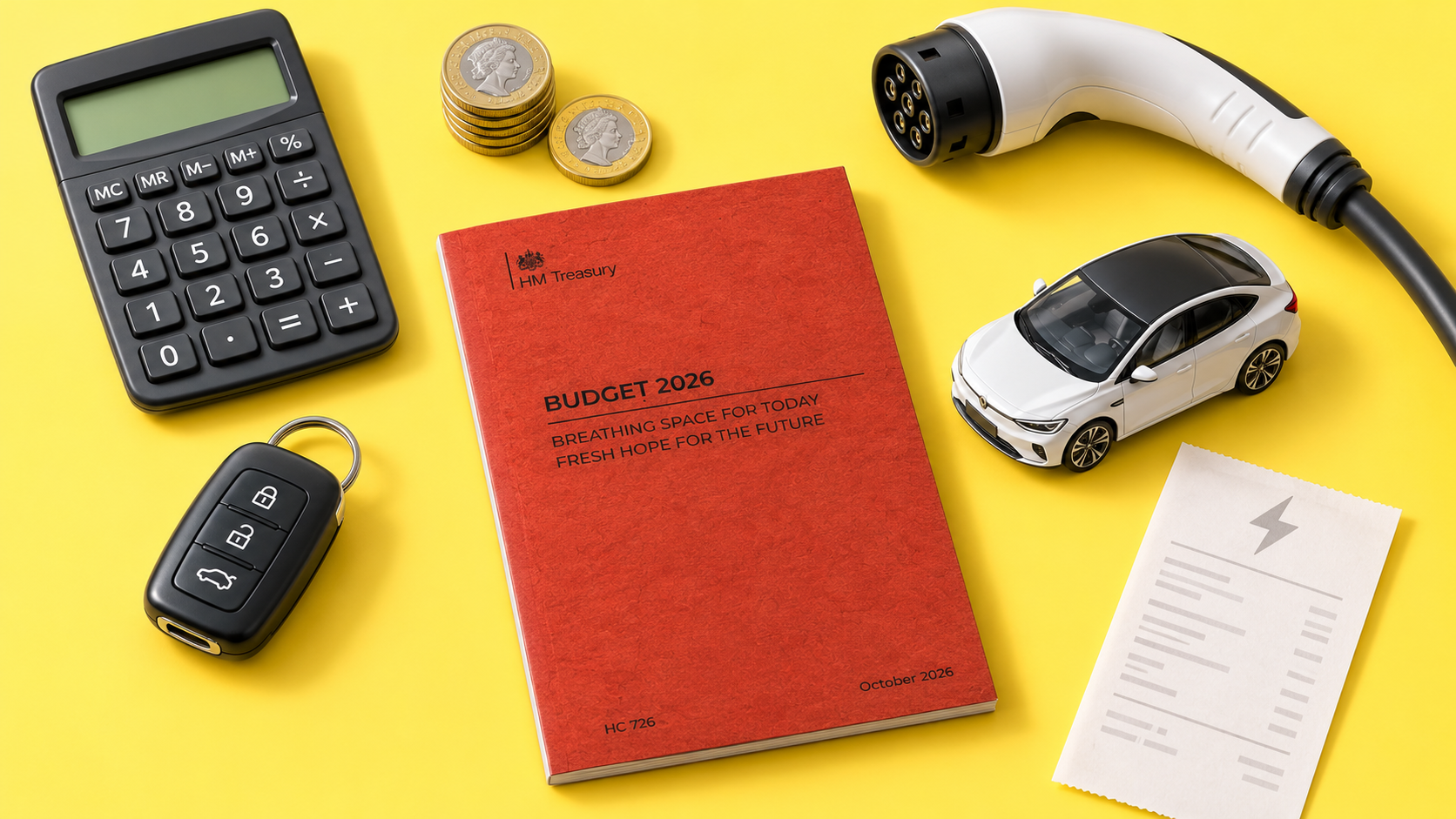
Here's what Budget 2026 means if you drive electric, run a fleet or operate electric vans.
Energy dominated this year's Budget. With the conflict in the Middle East pushing up bills, the government focused on bringing electricity costs down, and that matters to anyone who plugs in a car or van. Around the headline energy support were several smaller announcements that will shape what it costs to run an EV over the next few years.
We've been through the Budget documents and the industry reaction so you don't have to.
At a glance
The good news
- Company car tax is now set out to 2030-31. Fully electric cars are taxed at 4% this year, rising in steps to 10% in 2030-31, still far below petrol and diesel.
- £100 million over two years, from spring 2027, to cut the cost of local, lower-powered public chargers. The Treasury expects the average driver who charges on-street to save around £150 a year.
- The 0% VAT rate on household electricity now runs to July 2027, which helps if you charge at home.
- Pay-per-mile road tax gets practical fixes: a mileage estimator, an opt-in connected-car option and automated refunds.
- The 55p tax-free mileage rate for people using their own car or van for work is now permanent.
- New Warm Homes loans, some potentially at 0%, can help fund solar panels and home batteries.
What to keep an eye on
- Pay-per-mile road tax is unchanged at 3p a mile for electric cars and 1.5p for plug-in hybrids, from April 2028.
- Public and workplace charging stays at 20% VAT, now being written into law from 1 November 2026.
- The main writing down allowance falls from 14% to 12% from April 2027.
- The government's response to its ZEV Mandate review is due by the end of 2026.
Pay-per-mile road tax: confirmed for April 2028
Electric Vehicle Excise Duty (eVED) starts in April 2028 at 3p a mile for fully electric cars and 1.5p a mile for plug-in hybrids. The Budget didn't change the rates, but it did respond to feedback from the consultation:
- A mileage estimation tool, available from day one, to help you work out what to declare
- eVED Connect, an opt-in system that uses your car's built-in connectivity so you don't have to report mileage by hand
- Automated refunds by 2030, for example if you overestimate your mileage or sell the car
- Guidance for fleet operators promised later this year

The biggest worry we hear about eVED is the admin, so it's good to see that being taken seriously. Here's what the charge looks like over a year:
| Miles a year | Electric car (3p a mile) | Plug-in hybrid (1.5p a mile) |
| 5,000 | £150 | £75 |
| 8,000 | £240 | £120 |
| 10,000 | £300 | £150 |
| 12,000 | £360 | £180 |
| 15,000 | £450 | £225 |
| 20,000 | £600 | £300 |
For context, Polestar UK puts home charging at about 7p a mile on a standard tariff and as little as 2.3p off-peak, so even with eVED on top, charging at home stays very competitive with petrol and diesel. The eVED rate is due to rise with inflation from 2029-30. Electric vans are due to be exempt at first, as announced last year.
The leasing and fleet industry welcomed the practical fixes but not the tax itself. The BVRLA repeated that eVED is "the wrong tax at the wrong time", while Venson Automotive Solutions pointed out that a flat per-mile charge falls hardest on business drivers, who cover the most miles.
What it means for you: a lease signed today will likely run past April 2028, so it's worth building 3p a mile into your running costs now. High-mileage drivers will feel it most.
Company car tax: certainty to 2030-31
The industry asked for long-term certainty on Benefit-in-Kind (BiK) tax, and the Budget delivered another year of it. Zero-emission cars will be taxed at 10% in 2030-31, one point above 2029-30. Cars emitting 1-50g CO2/km, which covers most plug-in hybrids, go from 19% to 20%, and every other band rises by a point, up to the usual 40% cap.
The BVRLA called it a positive outcome, "even if it is just one more year of clarity". Fleet Operations said knowing the rates to 2030-31 will help lessors price four and five-year leases more accurately.
Here's what the rates mean for an electric car with a £40,000 list price:
| Tax year | BiK rate | Tax a year, 20% taxpayer | Tax a year, 40% taxpayer |
| 2026-27 | 4% | £320 | £640 |
| 2027-28 | 5% | £400 | £800 |
| 2028-29 | 7% | £560 | £1,120 |
| 2029-30 | 9% | £720 | £1,440 |
| 2030-31 (new) | 10% | £800 | £1,600 |
This is a simple illustration that ignores optional extras. Even at 10%, electric cars are taxed far more lightly than petrol cars, which sits at roughly 32% to 35% over the same years.
There's also a change to the paperwork. Mandatory payrolling of company car, van and fuel benefits, where employers collect BiK tax through payroll instead of a P11D, has been delayed by a year to 6 April 2027. It changes how the tax is collected, not how much anyone pays.
What it means for you: if you're taking a company car or salary sacrifice EV for the next three or four years, you can now see the tax rate for the whole term.
Charging: help for drivers without a driveway
If you don't have a driveway, this is the headline for you. Alongside the Budget, the government published Philip New's independent review into the cost of public charging, and it is acting on it in two ways.
- A £100 million fund. Over two years from spring 2027, the money will bring down the cost of local, lower-powered public chargers, the kind you find on residential streets and in car parks. The Treasury expects the average driver who charges on-street to save around £150 a year. The Department for Transport will set out how it works.
- A tariff porting taskforce. This will explore letting drivers use their home energy tariff at local public chargers. Under current proposals it would cover slower AC chargers rather than rapid chargers. It's a complex idea that will take time, but it could go a long way towards closing the gap between home and public charging costs.
There were two other changes to charging:
- VAT on public and workplace charging stays at 20%. The Finance Bill will confirm this from 1 November 2026.
- Business rates relief for chargepoints. Eligible EV chargepoints and EV-only forecourts get 100% business rates relief for ten years from 1 April 2026, a boost for the public network.
What it means for you: home charging remains the cheapest option by far, helped by VAT-free household electricity until July 2027. If you rely on public chargers, help is coming, but not until spring 2027.
Fuel duty and mileage rates
The 5p-a-litre fuel duty cut has been extended by six months to 1 July 2027, with the planned inflation-linked rise pushed back to the same date. The Treasury says petrol prices are up 33% and diesel 41% since February, and filling a typical 55-litre tank now costs around £24 more for petrol and £32 more for diesel than before the conflict began. It's a clear reminder of how exposed fuel costs are to world events, and why charging at home looks such good value.
For employees and self-employed people using their own car or van for work, the tax-free mileage rate is now permanently 55p a mile for the first 10,000 business miles, rising from 25p to 35p a mile above that. The rates are the same whatever the vehicle runs on, so drivers of efficient EVs can come out well ahead.
Fleets and electric vans
Most fleet bodies saw the Budget as steady rather than transformative: no nasty surprises, and a few measures that add up for businesses running cars and light commercial vehicles.
- Capital allowances. The main rate First Year Allowance rises from 40% to 50% for spending from 1 January 2027. It covers new vans and equipment, including those bought for leasing, but not cars or second-hand assets. The main writing down allowance falls from 14% to 12% from April 2027, which the BVRLA said will affect those who have invested in low and zero-emission cars. Full expensing stays in place.
- Van and truck support continues. The van grant of up to £5,000, the Zero Emission Truck grant and the Depot Charging Scheme, which covers up to 70% of installation costs, all carry on.
- The ZEV Mandate response is due by the end of 2026. The consultation on the Zero Emission Vehicle Mandate, which sets the share of new cars and vans that must be zero emission, closed on 23 October. Any changes would apply from 2027, and we'll be watching closely for what it means for supply and pricing.
- Running costs. Vehicle Excise Duty on cars and vans rises with RPI from 1 April 2027, and the Van Benefit Charge and fuel benefit charges rise with CPI from 6 April 2027.
- Mileage for own vehicles. The permanent 55p rate also applies to vans, a boost for tradespeople using their own van for work.
What it means for fleets: update whole-life cost models with the 10% BiK rate for 2030-31, the lower writing down allowance and eVED at 3p a mile from April 2028. Talk to your distribution network operator early about grid capacity and check whether you qualify for depot charging funding.
Energy: cheaper electricity for charging at home
Energy was the centrepiece of this Budget, and the cost of electricity is the biggest factor in what an EV costs to run. The headlines for drivers:
- VAT-free household electricity extended to 1 July 2027, expected to take around £50 off the annual price cap in April 2027. It applies to everything you charge at home.
- Electricity standing charges will be reformed, with details due next year. How costs are split between standing charges and unit rates could affect households that charge at home, so it's one to watch.
- New Warm Homes loans, some potentially at 0%, can help fund solar panels and home batteries, so you can generate and store your own electricity for the car.
What the Budget didn't include
Some of the most useful news is what stayed the same, and what's still to be decided.
- The Electric Car Grant carries on. There was no new announcement on the grant or on the £50,000 Expensive Car Supplement threshold for EVs, so both continue as set last year. The grant offers up to £3,750 off eligible new EVs and is funded to 2029-30. The government says it has already helped more than 160,000 drivers.
- Salary sacrifice remains a strong option. There were no changes to EV Salary Sacrifice schemes, so they continue to offer significant tax and National Insurance savings for many employees. The new cap on National Insurance relief from April 2029 applies to pension salary sacrifice only, not car schemes. The government has indicated it may look at the policy in future, but nothing has been proposed.
- Nothing new for used EVs. Company car tax is still charged on a car's original list price, however old it is. The BVRLA had asked for EVs aged three or more to be taxed on 35% of their original list price.
- No eVED rethink. Industry bodies asked the government to reconsider or delay pay-per-mile road tax. It hasn't.
Our view
This wasn't a Budget packed with new EV incentives, but it doesn't change the direction of travel either. Pay-per-mile road tax is still coming and public charging is still taxed at 20%, while the ZEV Mandate response is still to come.
There's real certainty in here too. Company car tax is now set out to 2030-31, the Electric Car Grant is funded to 2029-30, salary sacrifice is untouched, and with fuel prices up sharply since February, charging at home looks better value than ever. Add cheaper loans for solar panels and batteries, and the case for running on electricity you generate yourself has rarely been stronger.
For drivers, the message is to plan: check how 3p a mile fits your mileage and lease length. For businesses, it's to update whole-life costs now rather than wait for the final detail. A fixed monthly lease payment keeps the cost of the vehicle itself predictable while the rules around it settle.
Looking for a new electric car or van? Browse our latest special offers, or get in touch and our team will be happy to talk through what these changes mean for you.
Budget measures are subject to legislation, and details may change as the Finance Bill passes through Parliament.