








Charging electric vehicles at work
More and more employers across the country are offering charging access in workplace car parks, which serve as the next most-likely place an electric vehicle(EV) will spend time parked after the home.
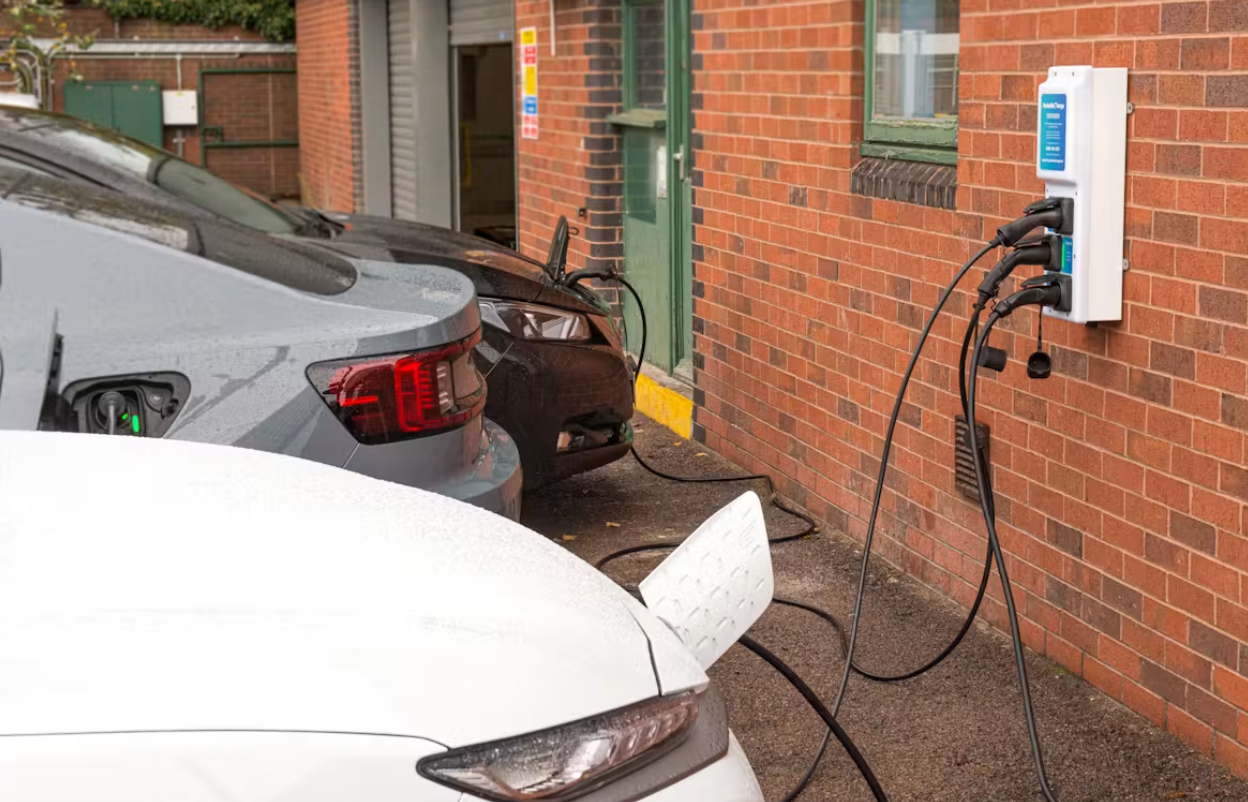
The ability to charge at work can potentially double an EV driver’s all-electric daily commuting range. For people with no off-street parking the ability to charge at work can make driving an electric vehicle a viable option.
At DriveElectric, we categorise workplace charging as the second most important place to charge, after the home.
The ability to charge at work can potentially double an EV driver’s all-electric daily commuting range. For people with no off-street parking the ability to charge at work can make driving an electric vehicle a viable option.
At DriveElectric, we categorise workplace charging as the second most important place to charge, after the home.
Benefits for employers and building owners
For employers and building owners, workplace charging adds value by improving employee benefits and making workplaces more attractive, modern, and future-ready.
Employee recruitment and retention
Workplace charging can play a valuable role in attracting, retaining and keeping employees happy. Offering EV charging shows that your organisation is forward-thinking and invested in modern technology, something that appeals not only to current EV drivers, but also to those considering the switch.
Furthering sustainability goals
Workplace charging supports sustainability goals by encouraging cleaner commuting and reducing transport-related emissions, while also enhancing public perception by demonstrating leadership in clean, forward-thinking technology.
Tenant attraction and retention
Building owners, managing agents and landlords who offer workplace charging at their facilities send the message that they are interested in providing smart, proactive solutions for their tenants’ present and future needs. Entering this fast-growing niche market today may yield significant benefits in the long run.
Evaluating and planning for workplace charging
Facilities ownership consideration
Implementing workplace charging is easiest when the employer owns and operates its campus or facility. Planning and installation will be more straightforward processes if the employer has singular control of the critical pieces of real estate, including the affected parking area(s), building(s), and electrical infrastructure.
Planning and installation may be more complex when multiple stakeholders are involved, particularly in densely developed urban areas. For example, a business may lease office space in a building that is owned by one entity, operated and maintained by another entity, with a parking facility operated by yet another entity.

Evaluating employee demand
Regardless of whether a workplace charging project is initiated by the employer or by employees, it will be useful to gauge potential employee demand. Employee surveys can be useful for this purpose. A survey should not only assess existing demand, but also help evaluate future demand. At DriveElectric, our team of electric vehicle specialists can perform a comprehensive suitability assessment of your staff. Please get in touch to find out more.
The organisation’s decision makers should evaluate survey results to help determine the number of charging stations that may be needed. EV production and ownership are expected to grow rapidly over the coming decade, so employers may want to allow for the possibility of future expansion when developing their workplace charging plans. This may include upgrading a facility’s electrical service beyond what is necessary for short-term demand.
Challenges for businesses in London: Grid & infrastructure constraints
Even though London leads the UK in many areas of electric vehicle adoption, fleets operating in the capital face some unique obstacles when it comes to installing workplace charging. One of the biggest is limited grid connection capacity: many sites in inner city or developed suburban locations can struggle to secure the power upgrades needed for ultra-rapid chargers or multiple simultaneous EVs.
Another issue is space and planning demand. The dense environment in London means fewer clearly available parking or charging bays, and longer lead-times for planning or building works. Borough reports show that for many companies it’s not just about installing chargers, it’s about working with the local authority, grid operator and parking strategy at once.
For your business, this means a few practical steps:
- Work early with your Distribution Network Operator (DNO) to assess grid head-room and estimated upgrade costs
- Consider buffered or battery energy storage systems (BESS) to reduce reliance on large grid upgrades, especially in grid-tight areas.
- Factor in longer project timelines and higher initial capital outlay for urban depots versus less constrained sites.
- Explore charge-scheduling and smart load-management strategy to maximise existing capacity and defer upgrades
By understanding these constraints early, you’ll be in a stronger position to plan charging infrastructure that supports your fleet, not one that constantly runs into delays or unexpected cost.
London Workplace Charging in Action
Struggling with grid and infrastructure limitations in London? See how one organisation tackled these challenges while transitioning to electric vehicles.

Case Study: KeolisAmey Docklands – GO-EV with DriveElectric
Discover how KeolisAmey Docklands implemented workplace charging in a complex urban environment and what lessons other businesses can take from their experience.